
How to Validate Your Startup Idea Before You Build
You’ve got an idea. It keeps you up at night—the kind of idea where you can see the final product, the happy customers, the big win. You’re ready to quit your job, hire a team, write the code, go live.
But… what if you build it and no one shows up?
Here’s a truth many don’t mention: the #1 reason startups fail is no market need.
Validation isn’t optional—it’s the smart, strategic part of building a startup. The fun part is building. The smart part is validating.
This guide is here to protect your dream, not derail it. We’re walking through 7 practical steps to validate your startup idea, from customer interviews to landing-page tests and even pre-selling your product. Plus, you’ll find proven tips from founders who’ve done this before—because inspiration matters.
Why “Just Build It” Is Terrible Advice
We’ve all heard that phrase—“Just build it!”—but it skips a huge part of the journey. That cost of not validating adds up:
Time: months spent building something nobody wants.
Money: resources invested in the wrong direction.
Morale: the emotional toll of realising you built the wrong thing.
Validation is your cheap insurance policy. You’re not just hoping your idea is good—you’re testing it.
The goal? Problem-Solution Fit. In other words:
Does the problem you’re tackling actually matter to people?
Is your solution the right way to solve it?
If you can answer “yes” to both before you build, you’re already ahead of 90% of startups out there.
Step by Step: The 7-Step Idea Validation Gauntlet
These steps form a ladder—from low-cost, low-risk to higher investment. Only move up when you get a clear green light.
Step 1. Define Your Core Assumptions (The Hypothesis)
Your idea is really just a bundle of guesses. Write them down:
The Problem: “My target customer [e.g., busy remote workers] struggles with [e.g., managing a healthy diet].”
The Solution: “They will pay for [e.g., a weekly AI-generated meal-plan app].”
The Customer: “The ideal user is [e.g., a 25-35 year-old tech professional].”
Documenting these turns vague hope into testable statements.
Step 2. Get Out of the Building (And Talk to Humans)
This isn’t about your app—it’s about the problem.
“Tell me about the last time you tried to plan your meals for the week.”
“What was the hardest part about that?”
“What, if anything, have you tried to fix this? Did you pay for anything?”
— Jeanette Mellinger, First Round Review on customer discovery. First Round
Speak with 10-15 people who actually have the problem and are actively trying to solve it. This kind of insight beats any assumption.
Step 3. Scout the Competition (And Find Your Niche)
No competition might seem good—but not always. If no one is solving it, ask why.
Look at:
Direct competitors (same problem, same solution)
Indirect competitors (same problem, different solution)
Pro Tip: Dive into 1-star reviews, Reddit threads, forums. Complaints = opportunities.
Step 4. Build a “Low-Fidelity” MVP (No Code Required)
Your MVP doesn’t need to be fully built—it just needs to be enough to test.
Options:
Concierge MVP: You manually deliver the service to your first users.
Wizard of Oz MVP: Looks like a real product, but humans run it behind the scenes.
Slide Deck or Mockup: A simple presentation showing value.
The question: Can you manually deliver the promised value? Once yes, you’re ready to scale.
Step 5. The “Smoke Test” Landing Page
A landing page is cheap and powerful. On it:
Clear Value Proposition: “Healthy meal-plans for busy pros in 5 minutes.”
Key benefits or features.
ONE CTA: “Join the wait-list”, “Get early access”.
You’re not building a full product yet—you’re testing interest.
Step 6. Drive Traffic (A $100 Test)
A landing page is useless without eyeballs. Run a small, targeted ad campaign ($100) on Google, Facebook, LinkedIn, or Reddit. Check if people click and sign up. This gives you unbiased data on interest.
Step 7. The Ultimate Test: Ask for the Money
“Sign up” is free—“pay now” is real.
Change your landing page CTA to “Pre-order now for a 50% founder’s discount.” If people pay, you don’t just have an idea—you have a business.
“If people are willing to pay for something that doesn’t exist yet, you don’t just have an idea. You have a business.”
— Startup validation wisdom.
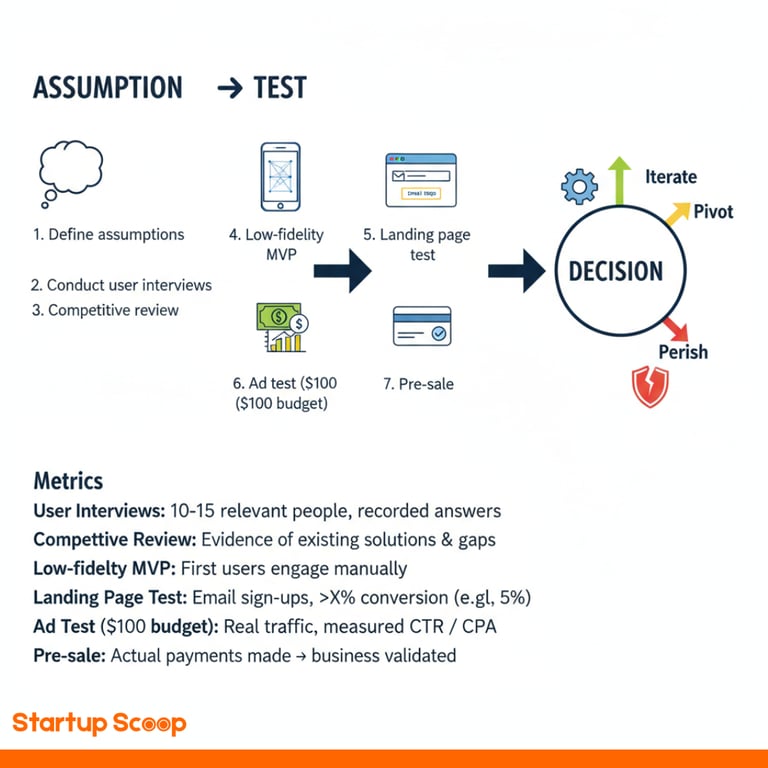
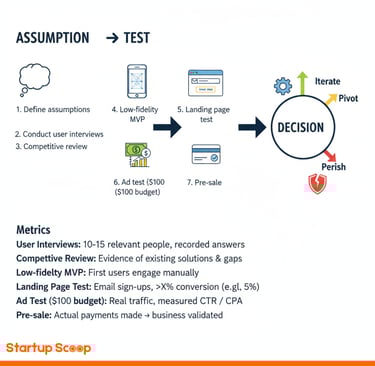
This isn’t rocket science—it’s simply structured learning.
What Now? How to Read the Data
Iterate: Early results good, but feature confusion exists? Improve and test again.
Pivot: Solution good, customer slightly off? Change your target.
Perish: No one cares? Be thankful—because you’ve saved time and money.
Remember: the goal isn’t to be right. It’s to discover what’s right.
Insight to check:
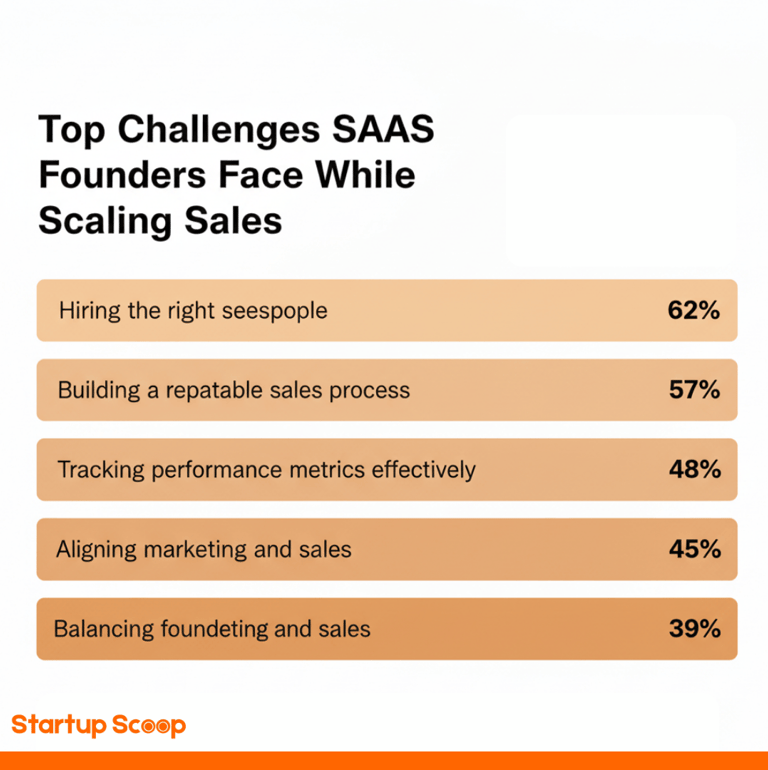
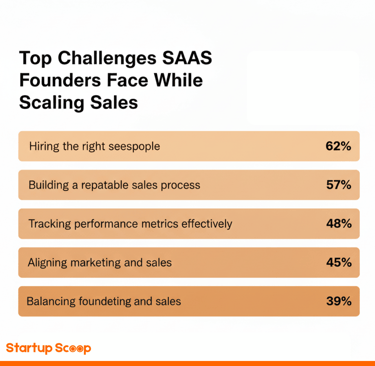
According to multiple founder interviews and data-backed studies, these are the most common bottlenecks when scaling from founder-led sales to a full team:
If you're a Founder --
Subscribe to 👉 Startup Scoop Weekly.
Get one story, one strategy, and one mindset shift — every week - to your Inbox.
Stop Guessing, Start Learning
Validation is not a task—it’s a mindset.
It’s about listening, adjusting, and acting.
Every successful startup began with small tests, deep humility, lots of learning.
So here's your challenge: pick one assumption about your idea today and test it.
Maybe talk to five people this week. Build a quick slide-deck next. Launch a landing page. Whatever it is—start smart.